Source: Babel
Author: Kateryna Lykhohliad
Published: June 23, 2026
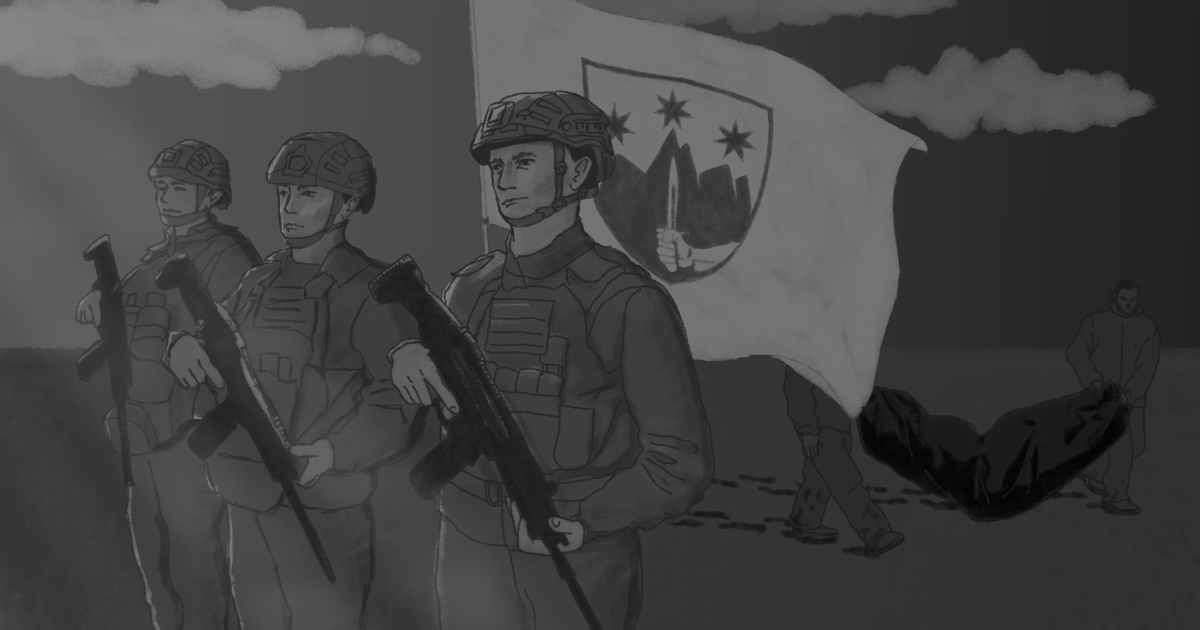
A battered head, lacerated arms, scraped-raw lower back, filthy and broken fingers — that was the condition in which 35-year-old Oleksandr Semenov walked into a hospital in Kropyvnytskyi in January 2026. He told doctors he had escaped from the 425th Separate Assault Regiment “Skelya,” where he had been tormented, beaten, tied behind an ATV, and dragged across the ground. In a video recorded by hospital staff, Semenov said he had witnessed at least nine suicides in the unit, briefly described their circumstances, and named one of the dead. The footage, obtained by Babel, was recorded on January 23, 2026; just days later, Oleksandr Semenov died in the hospital. His official cause of death was pneumonia.
Skelya is the largest assault regiment in the Armed Forces of Ukraine. Unofficially dubbed “Syrskyi’s Regiment,” it does not belong to any army corps and reports directly to the high command. The unit has fought in some of the fiercest battles of the Russo-Ukrainian war. Yet despite its combat record, the regiment draws frequent criticism from service members, journalists, and relatives of men assigned there. Accusations of catastrophic casualties have earned it a reputation as a “meat” regiment. Skelya, however, loses men not only at the front, but even before combat — during basic military training. Babel correspondent Kateryna Lykhohliad investigated the unit for nearly two months. Over the past six months alone, she documented 26 deaths across Skelya’s training centers. Most of the deceased had been in the regiment for less than a month, and in most cases the official cause of death was listed as pneumonia. To reconstruct how they died, Lykhohliad tracked down and interviewed more than 30 witnesses — primarily relatives of mobilized men, alongside roughly a dozen Skelya soldiers who either escaped from the regiment or still serve in it. Out of fear for their safety, most spoke on condition of anonymity while providing Babel with corroborating records; others agreed to criticize the regiment on the record. Drawing on their accounts, Babel examines how recruits end up in the unit, the conditions they endure, whether Oleksandr Semenov’s testimony holds up, and whether all of those deaths can plausibly be called natural.
Where “Ordinary People Become Invincible”
The homepage of Skelya’s website features smiling soldiers alongside the slogan “Here Ordinary People Become Invincible.” Its “About the Regiment” section outlines a brief history: Skelya began as a volunteer mobile fire group fighting Russian troops from the opening days of the full-scale invasion.
Its combat path runs through the hottest sectors of the war: Izium, Soledar, Bakhmut, Avdiivka, Vuhledar, and Pokrovsk. The regiment is commanded by Hero of Ukraine Yurii Harkavyi (call sign “Skala”), a full Knight of the Order of Bohdan Khmelnytskyi. The website promises rigorous training, modern weaponry, and top-tier supply — claims that are partly true.
“Equipment and supply in the regiment are ‘astronomical,’” says Ruslan Tsyhankov, First Deputy Military Ombudsman. Several soldiers we interviewed also praised the tactical instruction.
“I threw up for two weeks straight, but the combat training really was solid,” says an active Skelya soldier with dozens of assault missions behind him, speaking on condition of anonymity.
“The instructors are combat veterans — guys who have actually been in firefights. They know what they’re talking about.” Ten Skelya service members have been awarded the title Hero of Ukraine. Another defining trait of the unit is its sheer size. The regiment declines to disclose exact numbers, saying only that “whatever figure people cite [up to 13,000 personnel] is about right.” All of that represents one genuine, positive side of the unit. There is, however, another side — and it begins with the “Chicken Coop.”
The “Chicken Coop” is the informal name for Skelya’s intake and distribution point, the first stop where newly mobilized men are brought. It is a long, windowless building on the edge of a village that resembles an abandoned collective-farm shed.
Inside, it has been converted into makeshift barracks lined with fiberboard and partitioned into six sleeping sectors, with a washroom and a mess hall. Every sector is crammed with bunk beds.
According to eyewitnesses who passed through the “Chicken Coop,” the facility holds 1,000–1,200 men at any given time, many of whom struggle with substance addictions. Fresh recruits arrive continuously. Everyone’s mobile phones are confiscated back at the Territorial Recruitment and Social Support Center (TCC).
“Basically, they hauled us in, marched us out like prisoners from a paddy wagon, stripped us completely naked, searched our belongings, forced us to take off our underwear, and made us do squats,” recalls Oleksandr Zhykin of his arrival at the “Chicken Coop.”
Zhykin was brought there on February 15, 2026 — though not from a TCC. He had enlisted three years earlier after receiving a draft summons, reporting voluntarily and serving at brigade headquarters as a medical orderly and clerk. Everything went smoothly, he says, until a new commander took over.
Both before and during his military service, Oleksandr was enrolled in substitution maintenance therapy (SMT), a state-run medical program for people with opioid dependence. Under a narcologist’s supervision, patients receive prescribed daily medication — most commonly methadone — to suppress withdrawal and cravings. Properly dosed, patients lead stable lives, hold jobs, maintain families, and pose no danger to others.
According to Zhykin, his new commander confiscated his methadone, declaring that it had no place in the army. Oleksandr filed a police report: “He took away medication I literally cannot survive without.”
Zhykin was subsequently transferred to a reserve battalion, where the same conflict repeated itself: commanders refused to let him leave the base to pick up his prescribed dose. One day, Oleksandr left the unit on his own to get his medication. When he returned the next day, he was recorded as AWOL — and promptly shipped to Skelya’s “Chicken Coop.”
Normally, recruits spend only a few days at the “Chicken Coop” before so-called internal buyers from Skelya’s battalions arrive to select men for basic combined-arms training (BCAT). Some remain much longer: “I was there for two days, but there were guys who had been sitting there for two months. I even saw detainees who stayed on as orderlies,” Zhykin says.
Armed guards — whom another escapee refers to as vertukhai, prison-camp turnkeys — immediately make clear where the newcomers have landed: “A ‘priceless’ first trip to the latrine in groups at gunpoint, ‘refined’ insults, and heavy kicks if the line isn’t straight enough or your uniform looks wrong. Endless squats, planks, and ‘one-and-a-half’ drills so everyone ‘understands where they are’ and prepares for their upcoming ‘mission.’” Whether to the washroom or the mess hall, recruits move everywhere under armed escort.
“Just like prisoners of war,” Zhykin notes wryly.
Upon arrival, witnesses say, newcomers are sorted.
“Addicts get pushed to one side because they act erratically or are already sick. If they act out, they’re beaten savagely. The quieter guys wait their turn,” says another mobilized man who passed through the regiment.
For many recruits, acute opioid withdrawal sets in inside the “Chicken Coop.” Men lose the ability to sleep, suffer agonizing full-body pain, nausea, and diarrhea, and face an acute risk of suicide. Intravenous drips that slightly ease symptoms are given to only a handful, interviewees say. Those who descend into hallucinations and delirium are locked away.
“I can describe in detail spending two days in the punishment cell alongside four men in full delirium,” says one recruit on condition of anonymity. He had no addiction himself; his offense was refusing to do squats.
The punishment cell is a tiny room whose floor is almost entirely taken up by a single double mattress. Six or seven men were crammed inside at once, at least four of them in severe withdrawal.
“Each of them was trapped in his own hallucinations, talking to invisible people. They [the men in withdrawal] pounded on the door and went berserk. The guards quieted them down by spraying tear gas straight into the cell, and all of us had to breathe it,” the soldier recalls.
No one was let out to use the toilet; a plastic bottle sat in the cell for urination. At one point, the delirious men stripped naked, jumped around, and doused themselves with drinking water. Once the water ran out, they reached for the bottle of urine. For that, the cellmates who were not in withdrawal beat them.
“One of them started freezing afterward, yet refused to put his clothes back on or touch food. I remember him crawling under a blanket and defecating right there underneath it. Someone was masturbating too,” the witness recalls, struggling through embarrassment.
Several days later, he and another group of detainees were loaded onto vans for transfer to a training camp. Along the way, several men in an adjacent minivan smashed out a window and bolted. Guards chased them down, he recalls, and beat them in front of everyone.
After a few days in the “Chicken Coop,” Oleksandr Zhykin was assigned to the 3rd Infantry Battalion — even though his preliminary Military Medical Commission (MMC) ruling explicitly stated that he was unfit for service in air assault units.
“If a Sign Says ‘Mines,’ Don’t Test It With Your Foot”
Deep in a pine forest, several kilometers from the firing range, stand clusters of army tents. Each tent holds bunk beds for 35–40 men. That is how recruits held there this winter describe one of Skelya’s earliest training camps — and its harshest regime.
The regiment does not disclose how many training sites it operates. Beyond the intake facility, Babel identified at least four separate camps, with additional sites under construction. They differ mainly in whether recruits sleep in canvas tents or timber dugouts; according to former detainees, the rules are virtually identical across all of them.
The first rule recruits learn is that moving freely around the camp is forbidden.
“Even to use the latrine, you’re allowed to go only once a group of at least five men gathers — and only under the escort of a guard carrying an assault rifle,” says a witness who escaped after several weeks in the camp.
Two guards are assigned to every tent: when one escorts men to the latrine, the other stays behind. Stepping outside alone — even for fresh air — is prohibited. Everywhere recruits go, they march in formation. If someone falls out of step, a guard may fire several live rounds into the dirt or into the air.
“As they constantly remind you, every magazine is loaded with live ammunition — they can put a bullet through a recruit’s legs at any moment and face zero consequences,” the man says. “At first, after bursts like that, guys either forgot they needed the toilet or soiled themselves on the spot.” At night, Oleksandr Zhykin confirms, no one was allowed out to the latrines at all; guards ordered men to relieve themselves into plastic bottles.
Latrine escorts at gunpoint are an exaggeration, Andrii Surai, head of Skelya’s civil-military cooperation group, told Babel. Surai was the official designated to answer our questions about the accounts gathered from recruits; our two-hour interview continued afterward in writing.
“I haven’t seen anything like that at any of our training grounds. If an individual has shown a propensity to go AWOL, perhaps — but as a general practice, let’s say no,” Surai insists. Recruits move freely around the camp, he maintains, marching in formation only over longer distances to the firing ranges or the mess hall.
Yet recruits interviewed by Babel from multiple Skelya training bases describe not only armed guards, but also mined perimeters ringing the camps. Warning signs reading “Mines” hang along barrier tape around the tents. Some recruits saw only the signs; others heard detonations and witnessed their aftermath firsthand.
One man who spent several weeks in the tent camp recalls explosions nearly every night — often set off by wild hares or roe deer abundant in the woods. Animals, however, were not the only victims. He remembers a quiet, withdrawn recruit from Kharkiv in his forties who seemed disoriented and visibly struggled to process his surroundings.
Past midnight on February 26, 2026, after everyone in the tent had gone to sleep, a loud blast echoed outside, followed by screaming and a second explosion. Guards burst in, ordered everyone out of the tent, and held roll call. One man was missing.
Ten to fifteen minutes later, an ATV tore up to the formation driven by the camp’s chief of security, call sign “Fin.” Slumped behind him sat the missing man from Kharkiv, one eye covered by a bandage. Through shredded trousers, shrapnel-lacerated legs were visible. A guard yanked up his shirt, revealing a massive hematoma across his abdomen.
Addressing the ranks, the guards held him up as a warning of what happens to anyone who tries to flee: the man had lost an eye. Our source still does not know how the Kharkiv recruit slipped out of the guarded tent, guessing he crawled through a gap beneath the canvas.
According to the witness, “Fin” ordered the badly wounded man to drop to his knees before the formation. When he did not move, the security chief struck him, knocking him limp onto the ground, then drew a pistol and fired toward his body.
“We were lined up in three ranks. The guys in the front row could see the bullet hit the dirt beside him rather than his body, so they held up more or less okay. Those of us in the second and third rows took the spectacle much harder — my knees literally buckled. They told us once more that running was pointless and sent us back inside. We never saw ‘Isak’ [the wounded recruit’s call sign] again. Still, almost everyone parroted the guards’ line that he wouldn’t be medically discharged anyway — unlike us assault troops, he’d just spend the rest of the war digging trenches or doing some other ‘unworthy’ labor,” the witness says.
The witness recalled the wounded man’s first name as Oleksandr and his surname as either Isakov or Isaiev. Skelya confirmed to Babel that a mobilized soldier named Oleksandr Isaiev had indeed been at the camp, but offered a different account: “During training on February 26, he strayed from a designated route and set off an unidentified explosive device.” The regiment added that Isaiev died in a hospital on March 15 of cardiopulmonary failure.
Babel uncovered a second case in which a recruit was maimed by an explosive device at a Skelya training center. The survivor flatly refused to speak with journalists, but a close female relative agreed to speak anonymously and share medical records. The man had been at the camp for less than a month when he phoned home and said simply: “I stepped on a mine.” Regiment personnel drove the wounded recruit outside the base gates and told him to call his family to come pick him up.
“I don’t believe he was trying to run away. Everyone there knows the woods are mined — and that if you make any sudden move, they shoot you in the back,” she says.
When relatives picked him up, his wounds were still bleeding after several days of improvised field treatment inside the camp. His entire lower body from the waist down had been shredded; the relative counted roughly 50 shrapnel wounds, documented in medical records reviewed by Babel. Shrapnel tore through his legs, abdomen, groin, and urethra, with catastrophic damage to his genitals. Multiple surgeries — paid for by selling off family valuables — failed to restore function.
“He has already tried to jump out a window,” she says. Despite his severe physical and psychological trauma, she adds, the unit later moved to recall him to active duty in a medical company, forcing him into hiding. “‘Skelya never abandons its own,’” veterans of the unit often say — giving the regiment’s PR slogan a far darker meaning.
Oleksandr Zhykin tried to escape from Skelya almost immediately. The first camp he was sent to was an older forest site whose perimeter had not been mined. He and another recruit made a break for it during a latrine trip, bolting in opposite directions the moment the armed guard looked away. Guards immediately opened fire — aiming at their legs rather than into the air, Zhykin says — though the trees shielded them from the bullets. Search drones were launched overhead.
“Long story short, they tracked us down. Knocked out teeth, broke ribs — pure hell. And the guard I bolted from stood over me yelling: ‘You f*cking think I’m going to zero-line instead of you?’” Oleksandr recalls.
The regiment claims it heard about Zhykin’s beating for the first time from Babel, and denies that guards fire live ammunition at escapees. Asked directly whether the camp perimeters are mined, Andrii Surai hesitated at length before replying: “If a sign says ‘mines’ somewhere, you shouldn’t test it with your foot.”
“They Call the Guys ‘Disposables’”
Oleksandr Zhykin spent the next stage of his “training” locked in a barn. After the failed escape and beating, he says, guards wrapped him and his fellow escapee head to toe in duct tape, dumped them onto a bare concrete floor, and posted a sentry.
“For an entire week we urinated and defecated underneath ourselves. They brought food, but I barely ate or drank because I knew it meant needing the toilet.” Every so often, men walked into the barn to beat them with rifle butts and combat boots. It was February.
A week later, they were hosed down and moved to a cabin. On their very first night there, Oleksandr says, three of them knotted a blanket from a second-story window and fled again: “Thank God, at least the third guy made it out. The two of us got caught, beaten all over again, and thrown back into the barn tied up.”
After another 24 hours on the barn floor, guards marched the pair out, handcuffed them together, and transferred them to the main training ground.
“For a week we walked everywhere cuffed wrist-to-wrist like we were holding hands — we became camp celebrities. We even slept cuffed together on a top bunk; imagine trying to climb up there like that. If one of us needed the mess hall or the latrine and the other didn’t, both had to go. And we had our own personal guard with an assault rifle shadowing us nonstop,” Oleksandr says.
After a week, the handcuffs were removed and the pair were handed shovels to dig latrine pits and trenches. When Oleksandr asked permission to submit a formal transfer request, he says, “I got beaten all over again just for asking.”
Virtually every escapee interviewed described recruits being bound with duct tape at Skelya’s camps. At one training ground, Babel learned, a corner of a timber dugout was set aside for conscientious objectors who refused to bear arms on religious grounds. Later, guards began throwing men in acute drug withdrawal into the same dugout. Three witnesses independently recalled violent detainees being taped to support beams.
“They duct-taped them to a wooden post inside the dugout where we were held,” one witness explains. Men were left bound to the post for an entire day at a time.
Recruits with severe psychiatric illnesses were also dumped into the “religious” dugout, witnesses say.
“Anyone could see those men belonged in a psychiatric ward,” says one of the religious objectors. “We were forbidden to step outside the dugout, and you couldn’t reason with men in psychosis to stay put. Whenever they wandered out, the guards beat them with rifle butts, fists, and boots and threw them back inside to us. A few of our guys tried to care for them.” Eventually, guards padlocked the dugout from the outside.
Babel located one man with an obvious psychiatric disability who had been mobilized into Skelya, interviewing him alongside his mother. Even to a layperson with no medical training, his impairment is unmistakable — he struggles to articulate basic words. How he cleared an MMC remains unexplained. According to his mother, it was not the training camp that finally sent him home, but a frontline combat commander after deployment; until then, he endured training drills and beatings alongside everyone else. Babel also obtained anonymous testimony that recruits living with HIV, tuberculosis, and hepatitis C were held in the unit without access to life-sustaining medication.
One Skelya recruit recounted overhearing camp officers preparing for an incoming busload of conscripts: “They’re on the way — get ready, that’s another thousand ‘200s’ [killed in action].”
Oleksandr Zhykin recalls an almost identical scene: “Some chief of staff or senior officer walked up to our tent: ‘Who’s in here? Ah, 3rd Company — the disposables.’ And walked off. Can you imagine calling human beings ‘disposables’? Meaning one mission and you’re gone.”
An active Skelya soldier described witnessing what he called a “zombie apocalypse” at a formation where drug-dependent conscripts had just been unloaded: guards beat men while several involuntarily defecated in the ranks. Even though he personally opposes such brutality, he added, he later saw some former addicts emerge from training “transformed into real, motivated tigers.”
Asked what happened to those who never became “tigers,” his answer was brief: they went through the exact same BCAT pipeline and were sent into assault missions anyway — “with zero knowledge, zero skills, nothing.”
By law, anyone registered with a narcologist may enlist only voluntarily, explains Oleh Dymaretskyi, head of the All-Ukrainian Association of People with Drug Addiction (VOLNA). Plenty of Ukrainian service members on substitution maintenance therapy do serve voluntarily, coordinating medication pickups with their commanders before returning to combat duty.
“Speaking just for VOLNA, we have members on SMT with serious comorbidities who fought to the death in assault units around Kharkiv and Zaporizhzhia — 26 of our people have given their lives for Ukraine,” Dymaretskyi says. “But their heroism is no excuse to snatch patients off the street and claim anyone on methadone can do the same. No, they cannot. Those 26 were rare exceptions.”
According to VOLNA, 26,000 Ukrainians are currently enrolled in the state SMT program, 70% of them men. Diagnosed opioid dependence requiring ongoing treatment — especially alongside psychiatric disorders — is clear statutory grounds for medical exemption from military service.
Only in cases of mild past disorders or sustained remission may a Military Medical Commission rule otherwise. Yet most mobilized men interviewed by Babel said they never underwent a real medical exam at all: TCC staff simply handed them pre-signed fitness certificates.
Patients on substitution therapy are chronically ill, Dymaretskyi stresses, and cutting off their medication endangers both the patient and the unit. Abrupt methadone withdrawal inflicts excruciating agony that frequently drives detainees to suicide — or worse: “Three days into acute withdrawal, a man handed a rifle may cross over to the enemy or open fire on his own platoon.”
“I struggle to understand why people tell me I have to keep fighting for years on end while a man receiving state-funded methadone paid for by my taxes gets sent home — and I don’t get to go home to my children,” counters Andrii Surai of Skelya’s civil-military cooperation group.
Inside the regiment, talk of “social fairness” is common. Its ranks mix educated professionals with former convicts and men with addictions. Officers point to an undeniable reality: volunteers have dried up, especially for assault infantry, and frontline manpower shortages are acute — so the regiment works with whomever the TCCs deliver.
Responding to criticism over drug-dependent recruits in Skelya’s ranks, Surai is blunt: “If the MMC ruled him fit, he is fit. Whom are we supposed to believe — a man who dodged his civic duty for four years, or a medical commission?”
Sasha Zhykin never dodged service: he served from 2023 onward and, though currently listed as AWOL, wants to return to duty. “I’m still ready to serve today. We’ve petitioned every agency we can think of; we just don’t know how to secure a legal transfer.” He is willing to serve in logistics, medical support, guard duty, or communications — yet instead has to hide from Skelya.
While Oleksandr was locked inside the camp, his family searched frantically for him. The first time he briefly got hold of a phone, he sent and immediately deleted a text message: “Call the hotline every single day. At least they’ll stop beating me. I’m shitting underneath myself.”
Later, guards finally allowed him a supervised call on speakerphone. Sitting on a top bunk out of the sentry’s line of sight, Oleksandr quietly switched the call to video.
“Alive and well, everything’s great,” he recited brightly while angling the camera to show his battered face. His family recorded the screen.
Oleksandr’s father filed a formal complaint with the Military Law Enforcement Service — only for the complaint to be forwarded straight back to Skelya.
“My company commander called me in: ‘Thought you could f*ck us all over with a video call?’ I figured they were about to kill me and denied calling on video. He said, ‘I’m looking at a screenshot of your face right now,’” Oleksandr recalls.
The beatings stopped after that, though officers forced him to record a video statement claiming he was being treated well.
Zhykin finally escaped when his group was relocated to a new staging site — by sheer luck in his own hometown, whose streets he knew by heart. During a guarded trip to a grocery store, he bolted from his escorts and vanished.
According to relatives, Skelya hunted for him afterward: soldiers showed up at his father’s house, interrogated neighbors, staked out the street for several days, and phoned his girlfriend using the personal tablet he had left behind at the base.
“I Personally Cut a Kid Down From a Cord”
Oleksandr Semenov — the badly beaten 35-year-old who staggered into the Kropyvnytskyi hospital in January 2026 — had never refused military service either. According to his mother, Svitlana Khrystus, he tried to volunteer twice, in 2022 and 2024: “I personally packed his bag and waited outside the TCC for him.”
Passionate about cars and a skilled fast driver, Sasha hoped to serve on a medical evacuation crew. Both times he was turned away as medically unfit due to his enrollment in substitution maintenance therapy. Yet in January 2026, an MMC abruptly declared him fit, and on January 10 he was sent to Skelya.
Thirteen days later, on January 23, he walked into a hospital in his native Kropyvnytskyi covered in wounds and told doctors on camera: “They beat people half to death, tie you behind an ATV, and drag you over the ground until your skin wears off.” Sasha had escaped alongside several other recruits during a transfer between training sites.
Hospital footage shows multiple deep lacerations across his scalp, bruised and dirt-caked arms and legs, and raw, abraded flesh across his palms and lower back.
“I was the one who filmed him — and afterward I went back to my office and wept,” Tetiana Hurenko, head of the hospital’s substitution maintenance therapy ward, told Babel. Oleksandr was her longtime patient. Over that single winter, she said, 160 patients from their program were swept into Skelya — many seized right out of the hospital hallway.
In the video, Sasha recounted a string of suicides he had witnessed at the camp: “Maksym Skipa hanged himself using his body armor. Another kid climbed behind a toilet cistern and strangled himself — I personally cut him down from the cord. Then two more guys on their very first trip to the firing range took a single round each and shot themselves in the head. In four days, nine people killed themselves.”
Off camera, Hurenko recalls, Semenov added: “‘I never imagined human beings could beat you so badly you soil yourself.’” Alongside his head wounds and scraped torso, witnesses noted broken fingers and deep handcuff gouges around his wrists.
On February 27, Sasha died in the hospital. The death certificate listed pneumonia; police opened no criminal investigation.
“A soldier friend of mine came home on rotation that spring after Sasha’s funeral,” his mother recalls. “He couldn’t believe it: ‘What do you mean? We broke out of encirclement alongside Skelya — those guys were incredible fighters!’ Maybe some are. Clearly not all of them.”
Still traumatized, Svitlana declined to share everything she knows, adding only: “Every life destroyed there could have served the country in its own way. One man cleans latrines, another digs potatoes, another drives or fixes trucks, another takes down at least one enemy soldier. Losing a child is unbearable — whether to illness or in battle. Having your child tortured to death by his own side is something else entirely. It’s terrifying.”
In a written reply to Babel, Skelya stated only that Oleksandr Semenov had gone AWOL while being transferred from a training ground to a medical company, ignoring questions about beatings and dragging recruits behind ATVs.
Addressing Semenov’s account of camp suicides, the regiment wrote: “Allegations of mass suicides were reviewed by police; it was established that these incidents represented an aggregate across all units over a six-month period. Each case was properly documented. Most of the deceased were instructors, guards, and veteran soldiers.”
How an isolated conscript held without a phone for less than two weeks could have compiled six months of internal suicide statistics across the entire regiment, Babel cannot explain.
Skelya did, however, confirm the suicide of Maksym Skipa — the recruit Semenov named on video — claiming no signs of foul play were found and that Skipa “complained to fellow soldiers of feeling unwell without drugs.”
Babel tracked down an eyewitness mobilized alongside Maksym Skipa, who said Skelya personnel began beating Maksym while they were still inside the TCC.
“They caved his ribs in. His face turned deep blue-purple. They mocked him as ‘Blue-Eyes’: ‘Look at Blue-Eyes crawling — can’t even stand up!’” the witness recalls.
Guards beat Maksym after finding hidden methadone on him during a night strip search inside the TCC while awaiting transport. According to the witness, Skelya soldiers personally rode along with police patrols to snatch men off city streets.
Inside the TCC, the witness says, the Skelya troops got drunk on cognac, beat detainees, and then forced healthier recruits to “spar” against the already battered men.
“I faked my punches — how could I hit a man in that state? I’d swing wide and barely graze him,” Babel’s source says. Once at the training camp, the torment continued: “Maksym could barely walk. We helped him strap on and take off his plate carrier, because anyone caught without armor got beaten.” One morning, recruits woke up to find Maksym hanging dead.
Andrii Surai does not deny that violent incidents occur in the regiment, but insists they are not systemic: “Do situations happen where personnel tasked with getting reluctant men to carry out orders resort to non-regulation methods? Of course they do — everywhere. Do we combat it? Absolutely. Nobody has ever issued an order to beat recruits.”
Yet a former Skelya combat instructor says severe beatings in the unit require scant provocation. Rear-echelon specialists, he recalls, had their ribs broken in front of colleagues during staff meetings over Starlink outages or paperwork mistakes. He also witnessed guards setting dogs on conscripts. Both instructors and camp security, he says, routinely take part in abuse.
“Recruits are treated like convicts: marched out of the dugout at 6 a.m., marched back in at 6 p.m., period. If an instructor walks in and catches you sitting down, you get the sh*t beaten out of you,” the former instructor says.
Inspectors from the Office of the Military Ombudsman have visited Skelya’s training grounds repeatedly, though uncovering abuses across sprawling forest camps is difficult.
“Naturally, they try to stage a clean picture when inspectors arrive. At the same time, we analyze incoming complaints and investigate them systematically,” says Ruslan Tsyhankov.
Two anonymous sources told Babel that whenever outside inspections are scheduled, the most visibly beaten or defiant recruits are driven off the base for several days.
“It’s pure theater. Plenty of journalists visited while we were there, and the guards drilled us beforehand on telling them how great everything was. Showmanship, lies, bootlicking, and concentration camps,” says a soldier who survived both a Skelya training camp and frontline combat.
For precisely that reason, Babel declined Skelya’s invitation to tour a training center selected by the regiment: verifying abuse allegations on a prearranged visit where command controls both the site and the schedule is impossible.
“‘Skelya’ Means Certain Death”
Between late autumn 2025 and spring 2026, Babel documented 26 deaths among Skelya recruits. Most were previously healthy young or middle-aged men with neither addictions nor severe chronic illnesses.
While pneumonia appears on most death certificates, nearly every bereaved family interviewed by Babel or other media outlets describes prolonged, fatal denial of medical care.
Volodymyr Tsukanov, 32. Entered the regiment January 15; died in hospital February 11. Immediate cause of death: cardiopulmonary failure. Underlying causes: multiple rib fractures and blunt-force chest trauma.
Dmytro Koval, 50. Entered the regiment March 6; died March 21 inside a military vehicle. Listed cause of death: cardiomyopathy.
Vitalii Saltan, 34. Entered the regiment January 26; died in hospital February 22. Listed cause of death: pneumonia.
Oleksandr Semenov, 35. Entered the regiment January 10; died in hospital January 27. Listed cause of death: pneumonia.
Maksym Skipa, 37. Entered the regiment January 3; died January 9 at the military unit. Suicide.
Oleksandr Isaiev, 42. Entered the regiment February 25; died in hospital March 15. Listed cause of death: cardiopulmonary failure.
Serhii Chernoivan, 36. Entered the regiment December 1; died December 20. Listed cause of death: purulent pleuropneumonia.
Serhii Tabatskyi, 38. Entered the regiment November 3; estimated date of death November 25. Listed cause of death: cardiomyopathy. His body was found in a tree line outside the base.
Vadym Polyvanyi, 49. Entered the regiment February 9; died in hospital February 27. Listed cause of death: pneumonia.
Dmytro Shkoliarskyi, 34. Entered the regiment February 10; died in hospital February 26. Listed cause of death: pneumonia.
Serhii Holubov, 41. Entered the regiment November 8; died in hospital December 7. Listed cause of death: cerebral infarction.
Andrii Cherednichenko. Entered the regiment January 28; died February 14 inside an ambulance. Listed cause of death: pneumonia.
Oleksandr Kovalenko, 32. Entered the regiment February 21; died in hospital March 24. Listed cause of death: meningoencephalitis.
Viacheslav Hekalo, 37. Entered the regiment February 12; died in hospital March 6. Listed cause of death: pneumonia.
Dmytro Ivanchenko, 42. Entered the regiment January 6; died in hospital February 8. Listed cause of death: pneumonia.
Roman Kozharko, 45. Entered the regiment January 10; died February 14. Listed cause of death: gangrene of the right leg.
Denys Bahrii-Shakhmatov, 38. Entered the regiment February 1; died February 13 at the military unit. Listed cause of death: acute cardiovascular failure.
Vitalii Karat, 38. Entered the regiment February 25; died in hospital March 14. Listed cause of death: acute anemia of internal organs.
Vasyl Voichuk, 52. Entered the regiment March 13; died March 28 inside an ambulance. Listed cause of death: acute cardiopulmonary failure.
Vasyl Tsiurko, 41. Entered the regiment February 24; died in hospital March 4. Listed cause of death: acute cardiovascular failure.
Yaroslav Mokrii, 53. Entered the regiment February 26; died March 12 in a vehicle en route to hospital. Listed cause of death: chronic obstructive pulmonary disease.
Petro Danyltsiv, 52. Entered the regiment February 3; died March 11 en route to hospital. Listed cause of death: atherosclerotic cardiosclerosis.
Viacheslav Borysov, 31. Entered the regiment December 25; died in hospital January 23 following surgery for peritonitis.
Vitalii Batura, 43. Entered the regiment February 26; died February 28. Listed cause of death: cardiomyopathy.
Ivan Terentiev, 46. Entered the regiment March 1; died March 7. Listed cause of death: cardiomyopathy.
Volodymyr Belas, 47. Entered the regiment May 21; died June 9, body discovered in the woods. Listed cause of death: pneumonia.
Deaths among recruits fall broadly into two categories: deaths from untreated illness and deaths bearing clear signs of physical violence. Below are representative cases from both.
Vitalii Saltan, 34, Kropyvnytskyi. Saltan’s death has already drawn public scrutiny. Mobilized into Skelya on January 26, he died in a hospital on February 22 — a week after being admitted with a critically low blood oxygen saturation of 75%. Skelya disclaims responsibility, arguing that Saltan walked into the hospital under his own power and that everything afterward rests on civilian doctors.
Andrii Surai maintains that the regiment’s medical care is sound: “To audit our own medics, we brought in senior specialists from Ground Forces Command. Their inspection found zero protocol violations and no medication shortages, so I trust our staff. The Chief Medical Officer of the Ground Forces told us directly that ‘your medical service is properly organized.’” The Office of the Military Ombudsman strongly disagrees: “Frankly, medical care in the unit was demonstrably inadequate. That is an established fact — including in Saltan’s case,” says Ruslan Tsyhankov.
Saltan’s family is awaiting the results of an independent forensic re-examination, convinced that camp medics fatally delayed hospitalization while he burned with a fever above 40°C (104°F). Before falling critically ill, Vitalii told his fiancée, Anastasiia Polieva, how terrified he was of the camp’s brutality — though he never considered running.
“He told me the guys caught trying to escape came back flayed, beaten, scraped raw — as if someone had tied them behind a truck and dragged them down the road,” Polieva recalls.
The couple had planned to marry this July. “Every single week, no matter what, I visit his grave,” Nastia says. “What else do I have left?”
Dmytro Koval, 50, Volyn region. Mobilized into Skelya on March 6, Dmytro was dead by March 21. Although his preliminary death certificate listed unspecified cardiomyopathy, his widow, Liliia, barely recognized his body at the morgue.
“His face was gaunt — tortured, I would say. Bruises covered his arms, his legs, his neck. Across nearly the entire right side of his face ran a long welt, as though his head had been slammed against something. And in his back there was an inexplicable deep indentation, like a crater,” Liliia says. Only after the initial shock subsided did she identify her husband by the moles on his face.
After news of Dmytro’s death appeared in a religious community group, three fellow detainees who had been held alongside him in Skelya reached out to his family — the same three conscientious objectors who had refused service on religious grounds and are now AWOL.
Witnesses describe Dmytro as quiet and terrified, praying six to seven hours a day and refusing all food — whether out of religious fasting or protest against unlawful detention.
“I pleaded with him: ‘Brother, don’t try to argue your rights with these people,’” one eyewitness recalls. “Because the moment he mentioned his legal rights, they beat him senseless. They’d pummel him while he cried out, ‘Boys, what are you beating me for?’ Looking at his face, you could tell he couldn’t comprehend what was happening to him.”
Weakened by starvation, Dmytro shivered constantly and slept wedged between fellow recruits at night to stay warm. Guards ordered medics to force IV drips — purportedly vitamins — into his veins while other recruits held him down.
Demanding his release, Dmytro drew relentless retaliation. For roughly a week, the three believers brought him rations from the mess hall, which he refused to touch — earning daily beatings. The worst assault came after he promised guards he would eat, walked into the mess hall, and again pushed the plate away.
“They pounded him repeatedly on the head, grabbed him by the throat, hurled him to the floor, hauled him up, and threw him down again, kicking and punching him,” a witness says.
All three witnesses identified Dmytro Koval’s tormentors by call sign: two unit medics known as “Satan” and “Boks,” alongside the camp commander, call sign “Sych.” The camp’s security chief, they added, did not take part in the beatings and later went AWOL himself.
Babel put the question directly to Andrii Surai: when a camp commander personally beats detainees, is that still an isolated excess or a systemic failure? Surai replied that anyone proven guilty should be punished, but maintained that the regiment has no evidence of the incident — and sees no reason to trust deserters who never filed a police report.
None of the witnesses went to the police for an obvious reason: because they are listed as AWOL, walking into a police station would mean immediate arrest — the same catch-22 silencing nearly every escapee who witnessed abuses inside Skelya.
“That vulnerability is precisely what they count on,” one witness to Koval’s beatings says.
For more than a week after Dmytro vanished, Liliia called every hotline she could find — Skelya, the Ministry of Defense, and the Military Ombudsman. Finally, on March 8, an audio message arrived from an unfamiliar number in her husband’s voice: “Please pray fervently and bring in everyone you possibly can — the police too, if needed.”
Voices audible in the background made clear the call was being monitored. Liliia never heard her husband’s voice again.
Witnesses last saw Dmytro alive around March 14 before guards split their group up. A week later, he died inside a vehicle driven by Skelya personnel; investigators have yet to establish where they were taking him or whether he was still alive when loaded into the car.
An initial forensic report recorded unspecified cardiomyopathy with no mention of foul play — even while noting extensive bruising across his chest, back, ribs, shoulders, armpits, groin, and legs, which the examiner dismissed as “minor bodily injuries.”
Through the courts, Dmytro’s family forced prosecutors in his home district to open a criminal investigation and order a second autopsy to determine the true cause of death.
At 50, Dmytro had just begun building a family: he met Liliia at a church service several years ago, and their daughter Nelia was born in 2025. She is nine months old.
“I cannot accept men being beaten to death like this for nothing,” Liliia says. “I’m speaking out not just for Dima, but for other men too. People who say ‘I cannot bear arms’ can still serve society in countless non-combat roles.”
Volodymyr Tsukanov, 32, Mykolaiv region. Mobilized into Skelya on January 15, Volodymyr died in a hospital on February 11. While cardiopulmonary failure was listed as the immediate cause of death, forensic examiners documented blunt-force chest trauma and multiple broken ribs preceding it. Volodymyr was held at Skelya from January 15 to January 20; on January 21, he and 40 other recruits were transferred to the 1st Separate Assault Regiment.
Police investigators concluded that Volodymyr sustained fatal internal injuries during a savage beating on the morning of January 20, charging Skelya Junior Sergeant Anatolii Kucher. At his pre-trial detention hearing, Kucher confessed in open court — claiming he caught Volodymyr using drugs, “miscalculated his strength,” regretted what happened, and wanted to return to the front.
According to prosecutors, Kucher kicked Tsukanov three times in the chest with his left boot and kept kicking him in the torso after he collapsed, fracturing nine ribs. The chest trauma triggered bilateral purulent pneumonia, for which Volodymyr was hospitalized after arriving at the 1st Separate Assault Regiment.
Kucher remains the sole suspect charged so far, though through his defense lawyer he has since given Babel a completely different story — claiming he never beat Tsukanov and merely disarmed him after the recruit lunged for a guard’s rifle: “I ran up, leaped, knocked the weapon out of his hands, and fell on top of him. I never punched or kicked him.”
As for the severe injury to his own left leg — which required hospitalization and surgery — Kucher now claims he struck it against the rifle while falling, attributing his courtroom confession to “confusion.”
Initially, Skelya flatly denied that the arrested sergeant belonged to their unit at all: “We have no knowledge of any arrested ‘Skelya’ sergeant suspected of beating him. If such a sergeant exists, he serves in the 1st Separate Assault Regiment, not ‘Skelya.’”
Only after Babel provided Kucher’s full name did the regiment acknowledge him as its own service member, repeating the allegation about drugs — without explaining how a recruit strip-searched naked upon arrival could have possessed narcotics inside a locked camp.
Volodymyr Tsukanov did have a history of drug addiction. For years he had cared for his paralyzed mother until her death last year, followed shortly by his father’s death. His closest surviving relative, his sister Alona, lives far away. After losing both parents, she says, Volodymyr was trying once again to get clean — so when he was mobilized, she initially hoped military structure might help him.
“Never in my worst nightmare did I think I would find my brother in a morgue,” she says. Alona is demanding accountability not only for the sergeant who beat him, but also for officers at the second regiment who failed to treat a dying man.
Volodymyr managed two brief video calls with his sister before dying. On the first call, he told her he had been beaten: “He said he first landed among utter monsters who beat him mercilessly and treated him worse than a dog — ‘but now I’m with decent guys, everything’s okay, don’t worry.’”
On the second call, he mentioned being told his ribs were broken. She never heard from him again.
Vitalii Karat, 38, Ivano-Frankivsk region. Mobilized on February 25, 2026, Vitalii died in a hospital on March 14 of acute internal organ exsanguination. His death sparked national outrage following a report by public broadcaster Suspilne — compounded by Skelya’s bizarre official explanation that Vitalii had fallen out of a pine tree: “While serving, Vitalii Karat attempted to go AWOL. During a search, he was spotted high up in a pine tree. After speaking with personnel, he decided to climb down, lost his grip, and fell.” Autopsy findings, much like Volodymyr Tsukanov’s, revealed shattered ribs and severe blunt chest trauma.
Skelya insists it rushed Karat to a hospital immediately after his fall.
“We ourselves requested an X-ray because pneumonia was suspected,” Andrii Surai told Babel. “Doctors found pneumonia and a single fractured rib. That’s it — full stop. No pneumothorax, no internal bleeding, no blunt impact to the sternum. The next thing we learn, he’s in a Dnipro morgue with a dozen broken ribs, dead from internal exsanguination and blunt-force trauma to the sternum. Do you follow?”
Surai claims no one laid a finger on Karat at the training ground and suggests the fatal injuries occurred somehow at the hospital.
According to Surai, Skelya is cooperating fully with investigators: witnesses took polygraph tests and reenacted the incident on site. Yet in earlier public statements, Skelya spokespeople cited two broken ribs rather than one — and claimed to possess video footage proving the pine-tree fall. When Babel asked to see the video, none existed, only still photos from the post-factum reenactment.
Vitalii’s sister, Olesia Piskunova, says her brother told her directly before dying that guards beat him relentlessly and took him to a hospital only when he was already near death.
“They murdered him. They brutalize everyone there. ‘Skelya’ is a death sentence,” she says.
“We Simply Cannot Oversee Them at This Scale”
A wave of complaints against Skelya began building in late 2025, months after the 425th Separate Assault Battalion was expanded into a regiment early last year.
Today, Skelya far exceeds the size of a standard regiment. Pointing to its massive headcount, officers argue that the 26 non-combat deaths documented by Babel are statistically modest. Yet Babel’s list captures only cases journalists could independently verify; Skelya refuses to release its total training-camp mortality figures.
The Office of the Military Ombudsman confirms that the true death toll is higher — and that even adjusted for unit size, the 425th Separate Assault Regiment leads the Armed Forces in non-combat deaths.
“Proportionally, the rate of non-combat deaths in ‘Skelya’ is higher than elsewhere, though not by an astronomical margin. Deficient medical care is the primary driver,” says Deputy Military Ombudsman Ruslan Tsyhankov.
Verification is further hampered, he notes, by a structural blind spot at the General Staff: training centers report aggregate headcounts rather than named rosters, making independent tracking extraordinarily difficult.
Skelya also tops the Military Ombudsman’s complaint registry: out of more than 9,000 service-member complaints filed nationwide, 5.1% concern Skelya as a whole (spanning both training camps and combat battalions), ahead of the second-place 225th Separate Assault Regiment at 3.1%. Even those figures understate the gap, since recruits at most other training centers have far freer access to phones.
“That’s the crucial caveat I emphasize constantly,” Tsyhankov says. “Our numbers reflect only those who managed to get a message out. On paper the rate looks comparable to other units, but I know full well the underlying reality is worse.”
By way of contrast, Tsyhankov points to the 210th Separate Assault Regiment, which also runs its own basic training yet allows recruits daily phone access. Only after intervention by the Military Ombudsman’s Office did Skelya agree to let recruits call home three times a week.
Tsyhankov is equally unequivocal about MMCs clearing substitution-therapy patients for assault infantry: “Those men are in the Armed Forces unlawfully. We have to put a stop to this — every one of them must be discharged.”
The Military Ombudsman’s Office first confronted violence inside Skelya a year ago, when Military Ombudsman Olha Reshetylova practically had to extract beaten recruits from the unit in person.
“At a minimum, regiment command had an obligation to know what was happening,” Reshetylova said recently in an interview with Suspilne. “And if commanders genuinely didn’t know, that makes them poor commanders.” That earlier scandal reached both Commander-in-Chief Oleksandr Syrskyi and President Volodymyr Zelenskyy, forcing the regiment to open channels with oversight officials.
“Inside our regiment, the commander does everything possible to prevent ugly incidents,” insists Skelya spokesperson and former journalist Oleksii Bratushchak. “When abuses happen, subordinates try to cover them up rather than report them up the chain, until they surface through reporters or Reshetylova’s office. The commander’s stance is clear: investigate and make an example of anyone guilty. Honestly, it’s infuriating when we’re trying to build an effective fighting force and episodes like these tar our entire reputation.”
Image management has visibly become a priority for Skelya: public figures are invited to tour its facilities, and press officers respond swiftly to media inquiries and Ombudsman alerts.
According to Tsyhankov, however, that responsiveness operates purely as ad hoc firefighting: “Their playbook is simple: wherever they get caught red-handed, they rush to patch things up. Systemic reform is another matter entirely.” Fundamentally, Tsyhankov argues, Skelya has ballooned far beyond what a regimental command structure is equipped to govern.
In June 2026, Commander-in-Chief Syrskyi stripped eight military units of authorization to run independent basic training, stressing that how commanders treat recruits matters no less than the curriculum itself.
“Where commanders care for their troops, improve living conditions, build up training infrastructure, and ensure instructors mentor recruits with constant feedback, training quality rises and AWOL rates drop,” Syrskyi said.
Skelya was not among the eight units stripped of autonomous training rights.
“There are many honorable officers serving there,” says Military Ombudsman Olha Reshetylova. “Even as outrage against ‘Skelya’ surges across social media — much of it richly deserved — soldiers from this regiment are simultaneously holding nine brutal sectors of the front today. That is also true.”
While Reshetylova agrees that dedicated assault units fulfill a vital battlefield role, she warns that oversized, standalone formations defy effective oversight: “We simply cannot police units on that scale — especially if assault troops are spun off into a separate branch of service. The Military Ombudsman’s Office lacks the capacity, even though my team practically lives inside the assault regiments already.”
Instead, Reshetylova argues, assault units should be integrated into individual army corps — placing each under a corps commander who exercises direct oversight and bears personal accountability for what happens inside.